
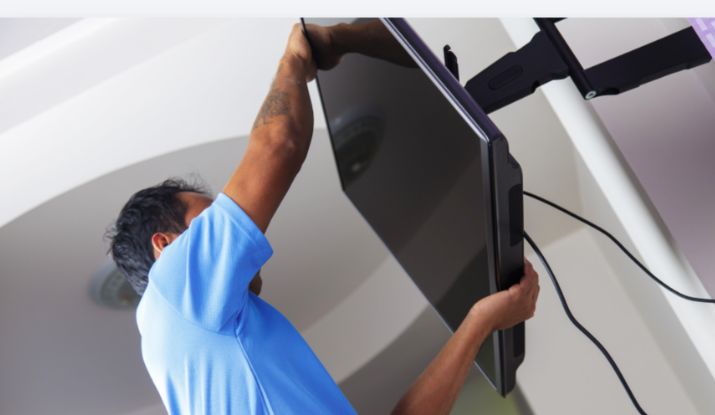
The hanging TV adds to the cleanliness and good design of the room, but picking the right holder for it is as significant an issue as picking the screen. The holder that will look fabulous in the showroom will turn into a real nuisance as soon as glare, viewing angle, or cable access problems arise.
The professional TV Wall Mounting Service in Melbourne can assist you in evaluating the wall, screen dimensions, viewing position, and holder type before installation. Metro TV Antenna, having more than 20 years’ experience in TV antenna installation throughout Melbourne, has a lot of practice in placing screens and their accessories.
There are three standard types of holders: fixed, tilting, and full-motion holders. Each of them is designed for different purposes, so the choice will depend not only on the aesthetics but on the way your family views TV.
Fixed TV Mounts: Clean and Minimal
Fixed bracketing keeps the TV near the wall surface; thus, they are recommended in scenarios where positioning is quite clear.
- Suitable for: Living rooms, bedrooms and designated viewing spaces where the television is placed facing the seating area.
- Strength: It provides a streamlined appearance.
- Consideration: Limited access behind the TV may be an issue, especially during cable installations.
- Tip: You should make sure to measure your TV properly before drilling. Having your mounted TV at too high a height can cause discomfort.
When simplicity is required in installation, fixed brackets may prove the easiest option.
Tilt TV Mounts: Better for Glare and Height
Without an extension arm, the tilting bracket can adjust vertically; thus, it is suitable where the TV should be placed above eye level.
- Suited for: Bedroom, fireplace, or wherever the TV is mounted above the seating position.
- Advantage: Tilting the screen downward helps to see it better and prevents glare from light.
- Drawback: The tilting bracket has limited left-right movement.
The case in point is that while a bedroom TV mounted on a fixed bracket may appear okay, placing it on a tilt bracket would improve viewing greatly.
Full-Motion TV Mounts: Maximum Flexibility
The full-motion bracket employs an articulated arm that is capable of tilting and rotating the television.
- Recommended for: Rooms where there is no specific seating area, corners, and more than one sitting area.
- Main strength: Ability to offer flexibility in terms of viewing angle from various locations.
- Installation tip: The TV will protrude from the wall; ensure that the mounting process does not become messy and that adequate support is provided.
TV Wall Mounting Installation in Woodstock may face difficulty with regard to awkward room arrangements since it may be hindered by room characteristics like furniture and windows.
How to Choose the Right Mount
The appropriate mount should fit the room rather than just the television.
- Take into consideration the viewing distance: a fixed mount works best for a fixed viewing distance.
- Natural lighting: a tilt or full motion mount will be helpful in minimising glare.
- Take wall structure into consideration: brick, concrete and plaster walls will require different mounting techniques.
- Accessibility: a full motion mount allows easy access to connections and other components of the TV.
Professional installation will also help in identifying any problems that might arise in future.
Common Mounting Mistakes to Avoid
Even the most well-made bracket won’t be of much use if it is incorrectly placed or mounted.
- Mounting the screen at an excessively high level may result in such issues as strain on the neck from prolonged viewing.
- Installing the TV on the wrong part of the plasterboard can reduce its stability.
- Not considering the cable paths can result in exposed wiring or difficulties in making modifications in the future.
- Using brackets without VESA compatibility can lead to installation difficulties.
- Disregarding soundbars, cabinets, or windows can influence the final positioning of the TV.
For families that need TV Wall Mounting Installation in Broadford, the best approach would be to plan the entire entertainment system.
Conclusion
There is a valid reason for each type to be used in a contemporary household. While fixed mountings are ideal when installation should be neat and easy, tilt mountings allow addressing the problem of high screen mounting and light reflection. Full motion mountings offer the highest flexibility.
In order to determine the right option, one needs to consider wall design, height of placement, room lighting, seating arrangement and use of the TV set. With a professional TV Wall Mounting Service in Melbourne evaluation, both mounting and screen placement will be done correctly. With the expertise of specialists like Metro TV Antenna, an ordinary TV installation can become safe, neat and comfortable.
FAQs
Q1. Are fixed mounts better than full motion mounts?
Not necessarily. Fixed mounts are easy and inconspicuous, while full motion mounts are ideal for areas where adjustments will have to be made in accordance with various positions.
Q2. Is a tilt mount good for mounting TVs in a bedroom?
Yes. Tilt mounts work well for mounting TVs above furniture like dressers.
Q3. Is it possible to mount any TV on the wall?
It is possible to mount almost all modern televisions as long as there is a bracket that corresponds to the VESA pattern, size and weight. The wall must also be suitable.
Q4. How high should wall-mounting be?
The best height would be that of the television’s screen at eye level.
Q5. Is a full motion mount harmful to the wall?
No. Not if the mount is done properly; otherwise, it could harm your wall.
Get Expert TV Mounting Advice Today
If you need help choosing the right TV mount, Metro TV Antenna can provide expert advice and professional installation. Contact Call us at 0421 094 024.