
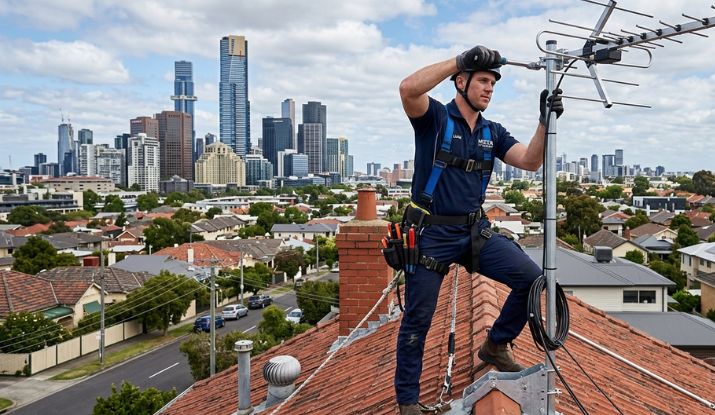
Why TV Antenna Installation Matters in Melbourne?
Getting crystal-clear free-to-air television in Melbourne requires more than just plugging in a cheap set-top box.
Whether you live in Croydon, Lilydale, Yarra Valley, Hurstbridge, Pyalong, Bentleigh, Brighton, Sunbury, St Kilda, or Frankston the quality of your TV antenna installation directly determines how well you receive channels like ABC, Channel 7, Channel 9, Channel 10, and SBS.
At Metro TV Antenna, we’ve helped thousands of Melbourne homeowners achieve stable, high-definition free-to-air reception. This guide walks you through everything you need to know — from choosing the right antenna to troubleshooting signal issues unique to Melbourne’s geography.
What Is a TV Antenna and How Does It Work?
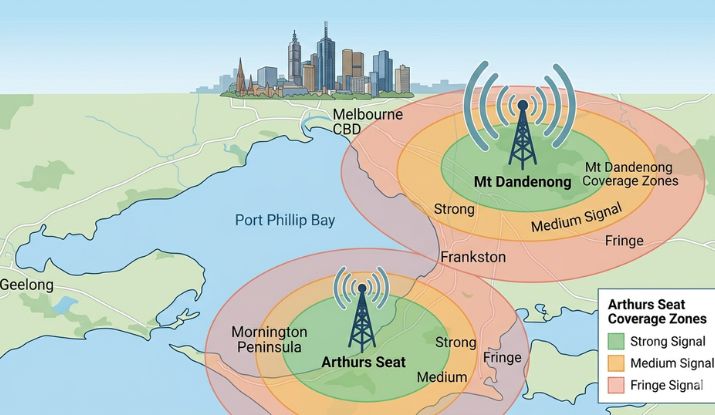
A TV antenna (also called an aerial) captures over-the-air broadcast signals transmitted from towers across Melbourne — most notably from Black Hill and Mount Dandenong transmitters. These towers broadcast digital free-to-air channels in UHF (Ultra High Frequency) bands.
A well-installed antenna converts those radio waves into a signal your television or set-top box can decode into sharp, high-definition picture and sound. The better your antenna’s positioning and quality, the stronger and cleaner your signal.
Types of TV Antennas Available in Melbourne
1. Outdoor Roof-Mounted Antennas (Recommended)
The most effective option for Melbourne homes. Mounted on the roof ridge or wall bracket, these antennas offer maximum signal capture — ideal for areas like Pyalong, Yarra Valley, and Hurstbridge, which sit further from broadcast towers.
2. External Wall-Mounted Antennas
A wall-mounted antenna is a great mid-range choice for inner-suburban properties in Brighton, Bentleigh, St Kilda, and Frankston, where signal strength is generally stronger.
3. Indoor Antennas
Suited for apartments and units in areas like St Kilda or Brighton where interference is low. However, indoor antennas often struggle with concrete walls and multi-storey buildings.
4. Distribution (Multi-Room) Systems
If you want a TV signal distributed across multiple rooms in your home — which is common for properties in Sunbury, Croydon, or Lilydale — a signal distribution system with an amplifier and splitter is the ideal solution.
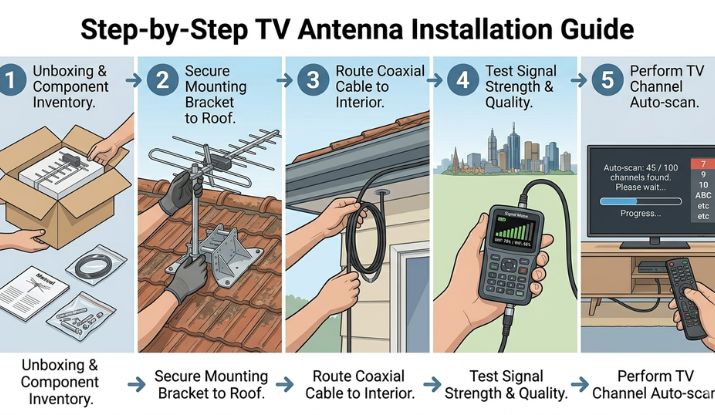
Step-by-Step TV Antenna Installation Guide
Step 1: Assess Your Signal Environment
Before purchasing or installing, check the signal strength at your location. Factors that affect Melbourne TV reception include:
- Distance from broadcast towers (e.g., Pyalong and Yarra Valley are 50+ km from Black Hill)
- Terrain and elevation (hills in Lilydale and Hurstbridge can cause signal shadowing)
- Nearby tall buildings or trees (common in Frankston, Bentleigh, and Brighton)
- Type of building construction (brick, steel-frame, or weatherboard)
Step 2: Choose the Right Antenna
Match your antenna to your suburb’s needs:
| Suburb | Signal Zone | Recommended Antenna Type |
| St Kilda | Strong (A/B) | External Wall-Mounted or Indoor |
| Brighton | Strong (A/B) | External Wall-Mounted |
| Bentleigh | Strong (A/B) | External Wall-Mounted |
| Frankston | Medium (B/C) | Roof-Mounted Outdoor |
| Croydon | Medium (B/C) | Roof-Mounted Outdoor |
| Lilydale | Medium–Fringe (C) | High-Gain Roof-Mounted |
| Sunbury | Medium–Fringe (C) | High-Gain Roof-Mounted |
| Hurstbridge | Fringe (C/D) | High-Gain Directional |
| Yarra Valley | Fringe (C/D) | High-Gain Directional |
| Pyalong | Remote/Fringe (D) | High-Gain Directional + Amplifier |
Step 3: Gather Your Tools and Materials
For a standard roof antenna installation you will need:
- TV antenna (matched to your signal zone)
- Antenna mounting bracket and mast
- Quality RG6 coaxial cable
- F-type connectors and compression tool
- Cable clips and weatherproof sealant
- Digital signal strength meter
- Ladder and safety harness
- Screwdriver, drill, and spanner set
Step 4: Mount the Antenna Bracket
Attach the mounting bracket securely to the roof ridge, fascia board, or chimney stack. For areas with strong winds — particularly Yarra Valley, Sunbury, and Pyalong — use a heavy-duty bracket rated for high-wind conditions. Always use stainless-steel fasteners to prevent corrosion in Melbourne’s variable climate.
Step 5: Position and Aim the Antenna
This is the most critical step. Using a digital signal meter (or the TV’s signal strength display):
- Point the antenna toward the Mount Dandenong transmitter (for eastern/south-eastern Melbourne including Frankston, Croydon, Lilydale) or the Black Hill transmitter (for northern and outer suburbs including Sunbury, Pyalong, Hurstbridge).
- Rotate the antenna slowly in 5-degree increments while watching signal strength.
- Lock in the position that gives the highest, most stable reading.
- Tighten all mast clamps firmly.
Step 6: Run the Coaxial Cable
- Route the RG6 cable from the antenna down the exterior wall, keeping it away from power cables (maintain at least 50mm separation).
- Use UV-resistant cable clips every 300–400mm.
- Apply weatherproof sealant at all wall penetrations.
- Keep cable runs as short as possible to minimise signal loss — particularly important for large homes in Sunbury and Croydon.
Step 7: Connect and Test
- Attach the coaxial cable to the antenna output port using a compression F-connector.
- Connect the other end to your TV’s antenna input or to the wall plate if using a distribution system.
- Run an auto-scan or channel search on your television.
- Verify all major channels are present with strong signal (aim for above 70% signal quality).
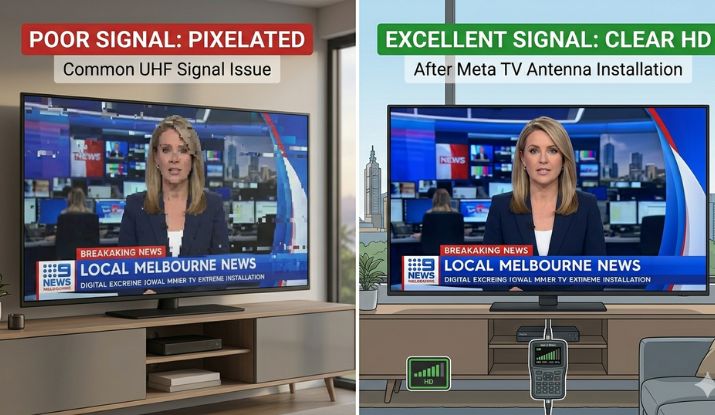
Common TV Reception Problems in Melbourne (and How to Fix Them
Signal Breakup or Pixelation
Cause: Weak signal, damaged cable, or loose connection. Fix: Check all connectors, replace deteriorated coaxial cable, and consider adding a quality signal amplifier — especially for homes in Yarra Valley, Hurstbridge, and Pyalong.
Missing Channels
Cause: Antenna pointed at wrong tower, or new digital channels not yet scanned. Fix: Re-aim the antenna and perform a fresh auto-scan on your TV.
Interference and Picture Noise
Cause: 4G/5G mobile towers, electrical interference, or reflected signals (multipath). Fix: Install a band-stop LTE filter on your antenna lead-in, or use a shielded cable. Suburbs like Brighton, St Kilda, and Frankston near the coast can experience multipath interference.
No Signal at All
Cause: Antenna mast knocked out of alignment (storms are common in Yarra Valley and Sunbury, severed cable, or failed distribution amplifier. Fix: Inspect the antenna for damage, check all connections, and test with a signal meter.
TV Antenna Installation for Melbourne’s Key Suburbs
Croydon & Lilydale
These eastern suburbs sit within medium signal range of Mount Dandenong. Most homes require a rooftop-mounted antenna with at least a 10 dBd gain. The hilly terrain in Lilydale can cause occasional multipath issues — a Yagi-style directional antenna pointed at Mount Dandenong delivers the best results.
Yarra Valley & Hurstbridge
Located in Melbourne’s fringe reception zone, homes in these areas benefit from a high-gain directional antenna (14+ dBd) combined with a mast-head amplifier. The natural bushland environment means antenna cables must be protected against UV exposure and wildlife damage. Metro TV Antenna recommends annual inspection for properties in these areas.
Pyalong
Pyalong sits in one of the more challenging reception areas in the Melbourne region. A high-gain Yagi or log-periodic antenna pointed toward Black Hill, combined with a masthead amplifier, is essential. Dish-style antennas may also be considered for very difficult reception points.
Bentleigh & Brighton
Inner-southern suburbs with generally excellent reception. Most properties in Brighton and Bentleigh require a simple external wall or eave-mounted antenna. High-rise apartments may need a professional signal survey to manage building reflections.
Sunbury
Positioned to the north-west, Sunbury receives signals from the Black Hill transmitter. Rooftop-mounted antennas with medium-to-high gain work well here. Newer housing estates may require a distribution system to serve multiple rooms.
St Kilda
One of Melbourne’s strongest signal areas due to its central proximity. Indoor antennas can work in modern apartments, though external units are recommended for older or brick-construction buildings. Channel interference from nearby properties is less common here than in fringe zones.
Frankston
Coastal location means some multipath issues are possible, particularly during summer when atmospheric ducting affects UHF signals. A medium-to-high gain antenna aimed at Mount Dandenong with an inline LTE filter is the recommended setup.
Do I Need a Professional TV Antenna Installer in Melbourne?
While DIY antenna installation is possible, a licensed professional from Metro TV Antenna ensures:
- Correct antenna selection for your specific suburb and signal zone
- Safe roof-access installation with appropriate equipment
- Accurate antenna alignment for maximum signal quality
- Weatherproofing all connections to Australian standards
- Compliance with AS/NZS 3000 wiring rules where applicable
- A workmanship guarantee on all installations
Working at height without proper training and equipment is dangerous, and an incorrectly installed antenna will continue causing reception issues. Our licensed technicians service all Melbourne suburbs including Croydon, Lilydale, Yarra Valley, Hurstbridge, Pyalong, Bentleigh, Brighton, Sunbury, St Kilda, and Frankston.
How Much Does TV Antenna Installation Cost in Melbourne?
TV antenna installation costs in Melbourne typically range based on the complexity of the job:
- Basic external antenna installation (strong signal area, single outlet): $150–$250
- Rooftop installation with cable run (medium signal area, 1–2 outlets): $250–$400
- High-gain antenna + masthead amplifier (fringe zone): $350–$550
- Multi-room distribution system (4+ outlets with amplifier): $450–$750+
Note: Prices are indicative. Contact Metro TV Antenna for a free quote tailored to your property and suburb.
Why Choose Metro TV Antenna for Your Melbourne Installation?
At Metro TV Antenna, we combine local knowledge with professional expertise to deliver installations that last. Our team understands the unique signal challenges across Melbourne’s diverse geography — from the dense inner-city apartments of St Kilda and Brighton to the fringe reception zones of Pyalong and Yarra Valley.
What sets us apart:
- Local Melbourne specialists with suburb-specific signal knowledge
- High-quality antennas and hardware designed for Australian conditions
- Fully licensed and insured technicians
- Fast response times across all serviced suburbs
- Competitive, transparent pricing with no hidden fees
- Workmanship guarantee on every installation
Frequently Asked Questions (FAQs)
Q: How long does a TV antenna installation take?
Most standard installations take between 1 and 3 hours. Distribution systems for larger homes may take up to half a day.
Q: Do I need a new antenna for digital TV?
If your existing antenna was installed before 2010, it may not be optimised for digital UHF channels. A professional inspection will confirm if an upgrade is needed.
Q: Can I get free-to-air TV in Yarra Valley and Pyalong?
Yes. With the right antenna setup — high-gain directional antenna and masthead amplifier — free-to-air reception is achievable in most parts of Yarra Valley and Pyalong.
Q: What channels are available via TV antenna in Melbourne?
Melbourne’s free-to-air lineup includes ABC (and ABC Kids/ABC ME/ABC News), Seven Network, Nine Network, Ten Network, and SBS — totalling over 20 channels.
Q: How often should I have my antenna serviced?
We recommend an inspection every 3–5 years for strong signal areas, and annually for fringe-zone properties like Yarra Valley, Hurstbridge, and Pyalong.
Conclusion
A properly installed TV antenna is your gateway to free, high-quality television across all of Melbourne’s channels. Whether you’re in the inner suburbs of St Kilda and Brighton or the outer reaches of Pyalong and Yarra Valley, the right antenna, professionally installed, makes all the difference.
Metro TV Antenna is Melbourne’s trusted choice for antenna installation, repair, and distribution systems. Contact us today for a free quote and let our experts deliver the clear signal reception your home deserves.